
The Bill
In 1601, the British East India Company documented that citrus fruit prevented scurvy. Sailors who carried lemon juice stayed healthy on long voyages. The knowledge was real, the evidence was clear, and it was written down. It took until 1795 — nearly two centuries later — for the British Navy to make citrus standard issue on its ships. In the interval, tens of thousands of sailors died of a disease that was entirely preventable with a solution that was already known. The knowledge existed, but the application did not. The gap between them is where the dying happened.
Semmelweis proved in 1847 that doctors washing their hands before delivering babies would dramatically reduce maternal mortality. He had the data. He published it. The medical establishment rejected him for decades. The women who died in that interval — and estimates run into the hundreds of thousands — did not die because the answer did not exist. They died because the answer could not survive the institutions it needed to pass through.
This is the translational gap. The distance between what is known and what is applied. Researchers in medicine call the space between laboratory discovery and clinical use the valley of death — and most things that could help people never cross it.
Somewhere, right now, something exists that could save a life. Maybe hundreds. Maybe thousands. The person who discovers it does not yet know its value. The person who could apply it has never heard of it. And between them sits every decision, every desk, every system that exists to move knowledge from one place to another.
Even in functional ecosystems — where peer review exists, where venture capital provides a pathway, where regulatory frameworks are navigable and institutions have some incentive to enable growth rather than extract — the journey from idea to application requires an almost unreasonable combination of will, resources, timing, and luck.
Millions of small decisions, each one a potential point of failure. The cumulative mathematics are brutal even under good conditions. A discovery that must pass through a thousand hands before it reaches the one that can use it has already, statistically speaking, died as a result of friction, indifference, and the sheer improbability of the right people finding each other across the distance.
This is the universal condition. Even where it works, it barely works. But it is not a tragedy in the dramatic sense. There is no villain, no deliberate suppression, no conspiracy. The loss is structural.
And the reason it matters enough to be worth naming before anything else is that what follows is an account of what happens when you take this already brutal probability cascade and run it through an environment specifically designed to extract from everything that passes through it.
The valley of death is the universal condition.
The Wall Is Not the Universal Condition
Every society has a valley of death. The gap between knowledge and application, between discovery and impact, between a good idea and a functioning reality — this exists everywhere. In functional ecosystems it is navigable, imperfectly, at great cost, by people with unusual combinations of will and luck. It is still brutal, and most things still die in it.
But in Nigeria, it has been expanded into a canyon by decades of decisions that prioritised extraction over everything else.
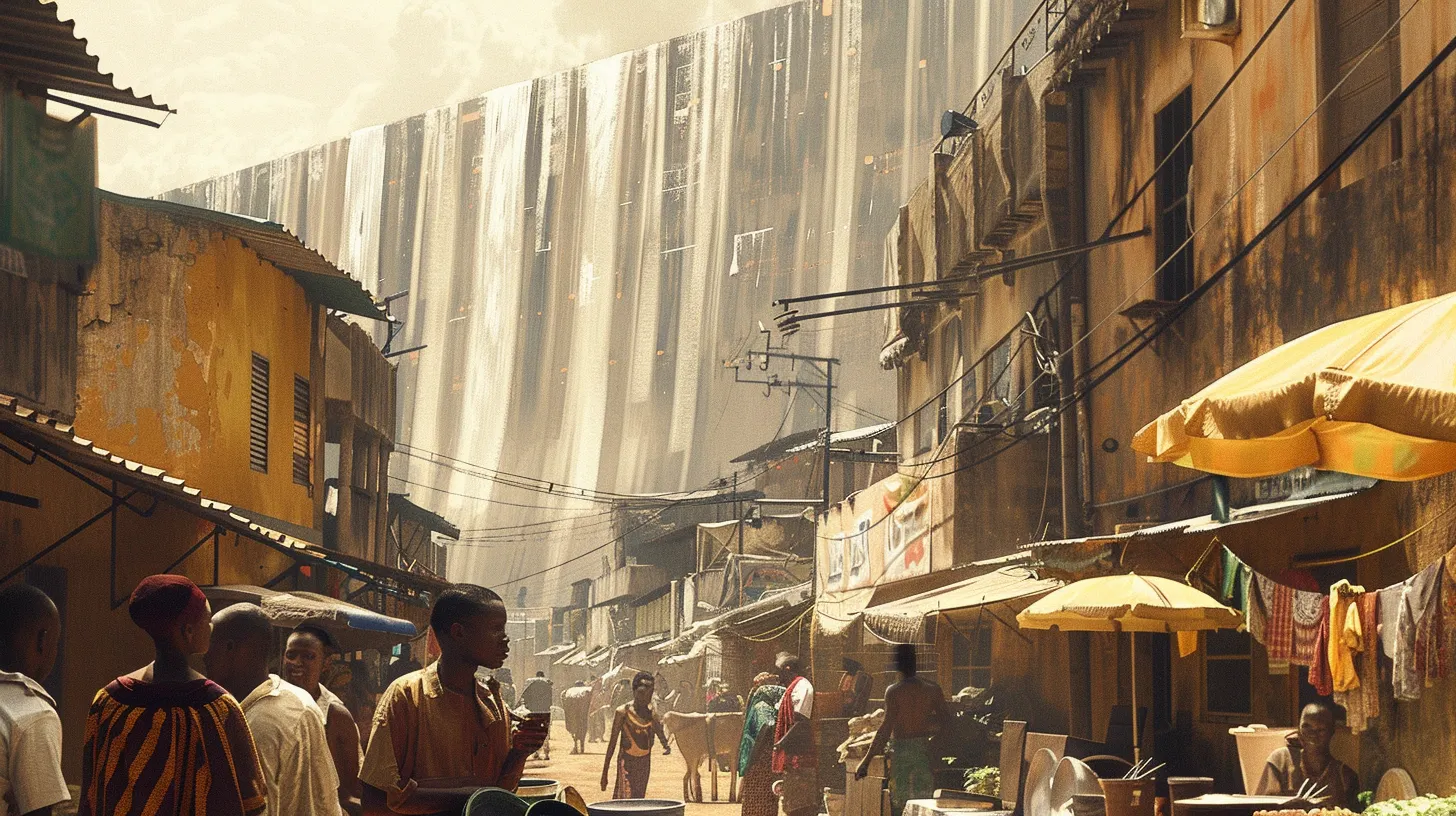
A valley has ground — it is depressed, difficult, but navigable. A canyon has walls on both sides with nothing reliable underfoot, and dimensions that a valley does not. The wall does not replace the translational gap. It surrounds it, acts on it, and multiplies every matrix of decisions that anything moving through it must survive. Each node is primed for extraction, with each interaction narrowing the probability of successful passage. The toll accumulates until the cost of moving something forward exceeds whatever any individual actor is willing to pay — and the idea, the discovery, the solution, dies prematurely because the environment consumed everything required to carry it.
This is what the current governance system produces reliably, across sectors, across administrations, across decades. Not just a wider gap, but one with active forces working against anything trying to cross it.
The question worth sitting with is not how this happened. The question is why it persists and why reform, when it comes, tends to make the canyon wider rather than narrower.
The answer begins with oil.
There is a relationship between taxation and accountability that political scientists have documented long enough that it is almost boring to repeat, yet its implications are rarely followed to their conclusion.
When a government taxes its citizens, it creates a feedback loop. Citizens give something of value. In return they expect something of value. Failure to deliver has political cost. The relationship is adversarial in the healthy sense — productive tension between people who need each other to function.
Oil inverts this entirely.
When a state's revenue comes from a resource rather than from its population, the feedback loop breaks. The government no longer needs citizens to generate income. Citizens become, at best, an administrative burden and, at worst, a threat to the orderly extraction of wealth. The accountability mechanism — the one that in other countries slowly, imperfectly, over generations, forces institutions to improve — simply does not activate. There is no internal pressure. The wall has no reason to develop cracks.
For over half a century, Nigerian governance has operated in this condition. Institutions were not built and then corrupted. They were architected from the beginning around access to centrally controlled revenue, which means they were architected around the capture of that access rather than the delivery of services. The wall was not an accident of bad governance. It was the predictable output of an incentive structure that was never pointed at the public good.
The talent leaves. The discoveries die in transit. The lives that could have been saved are not saved.
Now the oil is running out.
But before we get there — before the contraction forces the question — there is a move being made.
The current administration is not merely governing. It is positioning. Key institutional roles, the kinds that outlast election cycles and persist through administrations, are being filled with people whose primary qualification is loyalty to a political project rather than competence in the function they are meant to serve. Rather than working towards efficiency, they seek permanence.
Access to the country's financial architecture, its revenue flows, its regulatory chokepoints — these are being brought under the control of a network whose continuity is the point.
This is dynasty logic. And dynasty logic is not new to Nigerian politics, but its current expression has a particular quality of urgency to it, as if the people executing it understand, at some level, that the window is closing.
Here is the problem with dynasty logic applied to a failing state: it confuses capture with value.
The Nigerian Customs Service is the clearest example. Customs exists to regulate trade, protect borders, and generate legitimate revenue. In practice, the gap between official duty rates and what actually gets collected is so well documented it is almost unremarkable. The machinery of customs functions perfectly as an extraction apparatus while it fails at facilitating trade.
PHCN and the Discos follow the same logic. The electricity sector restructuring was designed to improve power delivery, yet the Discos that replaced NEPA inherited the infrastructure, the billing apparatus, and the regulatory relationships — and optimised all three for revenue collection rather than service delivery.
In the early 1970s, a man named John Dodd built a car called The Beast — a custom body wrapped around a 27-litre Rolls-Royce Merlin V12, the same engine that powered the Spitfire. It produces an estimated 750 horsepower. It gets two miles to the gallon. It has been driven on public roads.
It is, by any engineering standard, a remarkable achievement.

It is also completely useless as a car.
Too loud, too heavy, too expensive to fuel, optimised so completely for something other than driving that the original purpose of the vehicle has been entirely abandoned. What John Dodd built is not a better car. It is something that was once a car, rebuilt around a different purpose, that can now serve neither.
This is what happens to an institution when every component is reoriented away from its original purpose.
You do not get a functional institution staffed by loyal people. You get a loyalty apparatus that performs the aesthetic of an institution. The difference is not cosmetic. It determines whether the thing can actually do what it claims to do — collect revenue effectively, regulate markets, deliver services, respond to crises.
And the selection mechanism compounds itself.
Competent people, given the choice between an environment that rewards competence and one that punishes it, will leave. What remains selects for what is rewarded. Over time, the institution loses even the institutional memory of what functioning looked like. The people running it have never worked anywhere that worked — which is practically every single ministry in the country at this point.
For a dynasty to mean anything, it requires a kingdom. For a kingdom to be worth anything, it must produce something someone values.
You cannot inherit control of a machine and call it wealth if the machine was never built to run.
And no, Afrobeats is not a sufficient output for such a monumental failure.
Which brings us back to the oil.
It is running out — not immediately, not completely, but the trajectory is visible to anyone willing to look at it honestly. The global energy transition is a structural shift in the international demand for the resource that has funded Nigerian statehood as it has actually functioned. The political class has known this for years. The response has been, predictably, to attempt to extract more from the remaining population before the window closes.
This is the honest description of what tax reform in Nigeria is.
The official language is modernisation. Integration of the tax base. Formalisation of the informal economy. Alignment with international best practices.
Some of that language is sincere. There are people inside the system who genuinely believe they are building something better. But the structure underneath the rhetoric is a government that has never built the accountability relationship with its citizens, now attempting to collect from those citizens, without first becoming the kind of institution from which collection is legitimate.
In late 2025, four tax reform Acts passed by the National Assembly came to public attention for a reason that had nothing to do with their content. When the officially gazetted versions were compared against the Certified True Copies of what parliament had actually debated and passed, the documents were not the same. The House of Representatives confirmed the discrepancies.
Three different versions of one Act were found in circulation simultaneously. What had been quietly removed in the transition from legislative chamber to official gazette were the provisions requiring the new revenue authority to report to parliament — the oversight mechanisms that would have allowed elected representatives to hold the tax collection apparatus accountable.
The law the public received was not the law the legislature passed. And the specific provisions that changed were the ones that would have made the system answerable to someone.
This is the wall doing what the wall does. It does not simply obstruct. It rewrites — and it rewrites precisely the parts that would have constrained it.
The people who will pay the new taxes are a population already living at material standards that, in aggregate, fall below those of citizens in active conflict zones.
In early 2026, Abuja — the capital, the seat of the administration that governs all of this — ran dry. Thousands of residents struggled with empty taps, paying inflated prices to private water vendors to survive.
Sources alleged that up to 70 percent of the water from the Usuma Dam had been diverted to a private farm in Ushafa linked to the FCT Minister's family. The allegation has not been independently confirmed. What has been confirmed is that residents of the same Ushafa community where the farm sits also ran dry.
A resident described watching water and electricity flow past his home and into the farm while he had not bathed in days. Whether or not the diversion happened exactly as alleged, the image it produces is accurate: in Nigeria, the infrastructure of the state flows toward power, and away from everyone else.
The rot is distributed.
And this is where the political class has made its most consistent miscalculation. The promise that sustained Nigerian politics through its most turbulent decades was ethnic in character — the idea that capturing the centre was a project that benefited your people specifically. Access to federal revenue, contracts, appointments, protection. The logic of ethnic loyalty made sense as long as the spoils were real enough to distribute, as long as proximity to power translated into measurable material difference for the community it claimed to serve.
It no longer translates, because the wall does not discriminate.
The discovery that dies in transit does not die only on one ethnic community's behalf. The life not saved is not saved regardless of where it was born. When the infrastructure fails, it fails for everyone within range of it. When the tax expands without accountability attached to it, the burden falls on whoever is formalised enough to be visible to the collection apparatus — and that is increasingly everyone, everywhere, from every community.
What you cannot promise people is what you cannot deliver. And you cannot deliver what the wall does not permit to pass.
The Arithmetic of Winning
Let us follow the logic of the people making these decisions honestly, to wherever it ends.
You have secured power. You have positioned loyalists in the institutions that control revenue. You are building toward something that outlasts your term, perhaps outlasts you.
In the conventional language of political ambition, this is winning. But look at what you are actually inheriting.
You are gaining increasing control over a land of declining value. The population is being diminished educationally, nutritionally, mentally, financially. The currency in which your power is denominated loses value every year, because the domestic economy that could support it was never seriously built. The natural resources beneath the ground are either going to waste or being sold to foreign interests at prices that reflect what happens when the seller has no leverage, no alternatives, and no real capacity to extract value for themselves.
You take money out of this system. Of course you do. But where does it go?
If it stays in naira, it degrades with everything else. So it moves. Properties abroad, accounts abroad, children raised abroad, a life conducted in countries that function. And here is where the arithmetic becomes unforgiving. Those foreign assets hold their value in foreign currency. Maintaining them — the taxes, the upkeep, the cost of ordinary life in a stable country — requires a steady, replenishable supply of hard currency.
That supply can only be replenished by doing the thing you never did: building something that earns in real terms. Something that produces rather than extracts. You never built that. Which means the foreign assets sit on a foundation you cannot refill.
This form of corruption writes you into a corner.
When the extraction slows — and it will slow, because assets deplete and populations reach their limit — there is nothing to fall back on but more extraction from a source already approaching exhaustion. The strategy that felt like winning turns out to have been a tightening noose.
Perhaps the stockpile holds long enough for three generations to stumble around the world and find their footing. Perhaps the grandchildren become something — ordinary, even, which is all most people ever wanted.
Perhaps that feels, from a certain distance, like enough. The damage by then will be complete and irreversible.
The discoveries that died in transit will not be recovered. The generations raised in diminishment will carry it forward in ways that compound beyond any calculation. The social fabric restructured around survival rather than aspiration does not simply return to what it was when conditions improve.
And the inheritance — the thing you spent a country to accumulate — will turn out to have been enough for one lifetime, stretched thinly across several, running dry before it becomes anything as durable as the legacy you imagined when you started.
You did not build a dynasty. You built a one-time extraction event and gave it a family name.
Underneath all of this is an assumption so embedded it is almost never named: that the country can keep giving. That the population will absorb each new imposition. That the informal economy will keep generating activity even as formal conditions deteriorate. That the resource base will hold. That the talent that left will be replaced.
History has not been kind to this assumption. Not here, not anywhere.
The asset always runs out before the appetite does, which is why you do not destroy what you eat from.
The ecologist calls it the tragedy of the commons. The economist calls it the resource curse. The evolutionary biologist notes that even the most efficient parasite learns not to kill its host. The folk wisdom of virtually every culture on earth has a version of this observation, usually expressed in terms too blunt for formal company.
It is basic arithmetic. And arithmetic does not negotiate.
Extracting from over 200 million people sounds like an enormous prize, but decades of deliberate underinvestment in education, healthcare, and infrastructure do not leave 200 million people intact and available to be collected from. They produce communities whose aggregate economic output has been compressed so completely that the GDP of an entire town with real people living real lives is functionally less than the compute value sitting on a single desk running a locally hosted AI model.
And when that reality becomes impossible to deny — when the appeals for foreign aid arrive and the arguments about extortion by superior forces are made, when the claims about fundamental rights withheld by outside powers are filed — understand what is actually being said.
That the condition was chosen.
Not by outsiders or some cruel history, but by the specific decisions of the specific people who held the structure and chose, decade after decade, to endlessly consume rather than build.
The generation that made the decisions will read it as accusation. It is not — or not primarily. It is the conclusion of an arithmetic they set in motion, one whose final figures are only now becoming visible. The extraction felt like accumulation. The distinction only becomes clear at the point where the source runs dry and the accumulated total turns out to be smaller than the opportunity cost of how it was gathered.
The generation inheriting it will read it as explanation. They are the ones beginning to notice, in London flats and Houston suburbs, that the stockpile has a bottom — and that the people who filled it also systematically drained the conditions that could have replenished it. They did not make these choices. But they are receiving the results of them, and the distance between what they were promised and what they are finding is a reasonably precise measure of what was removed from the country that was supposed to produce their future.
Self-immolation is the entirely predictable output of a system optimised for endless extraction to the point where it has consumed the very conditions required for its own existence.
A fire lit by the people standing in it, who remained convinced until very late that they were simply warm.
The wall was never keeping anything out. It was never built for that.
It was built by people who understood exactly what it was for — and then handed to people who needed something completely different from it, and who never quite figured out how to build that something.
What they figured out instead was how to collect from what they had inherited. And so the wall's original purpose was abandoned, the purpose Nigeria actually needed was never built, and what remained was the structure itself — occupied by people who confused owning the keys with owning the value of what was behind the door.
Their children will spend their lives learning that it is not the same thing.
There is no winning here. Not for the country.
And in the end, not for them.