
The Wall
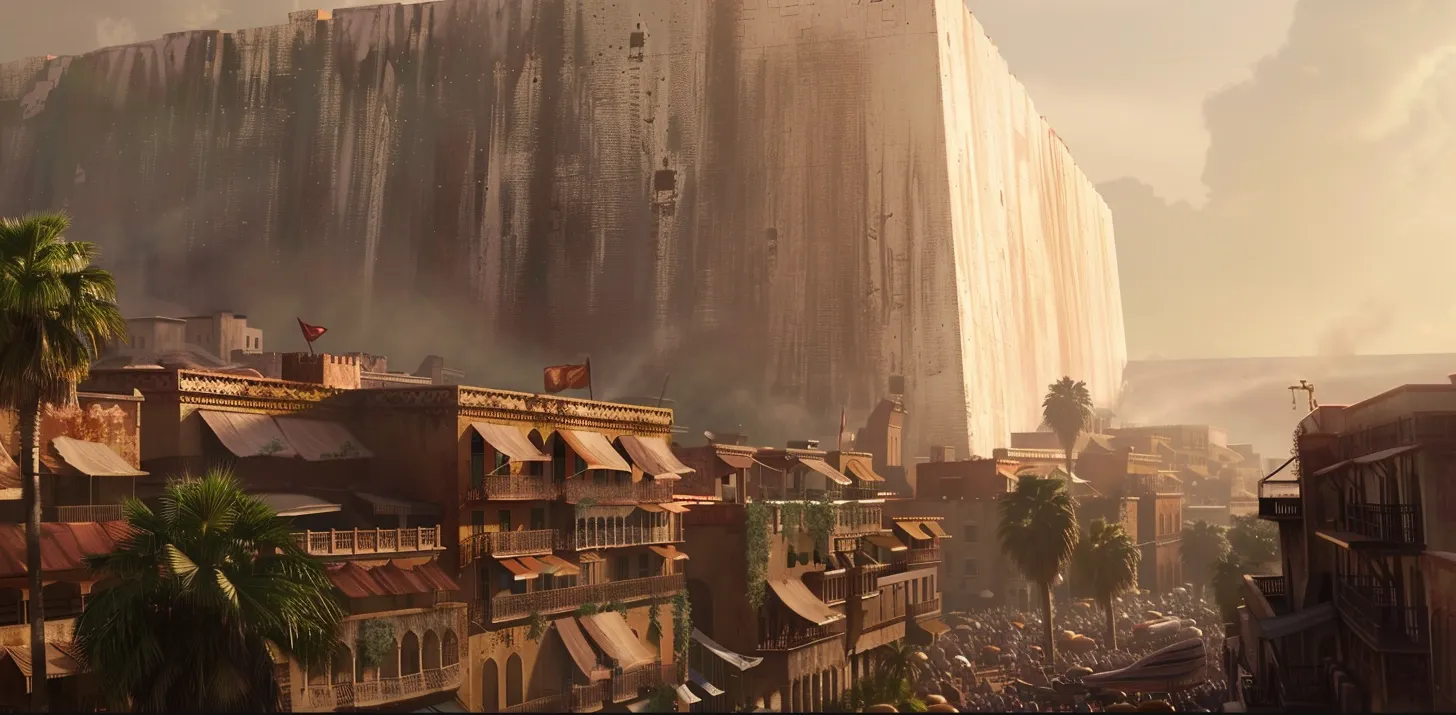
Every country has one.
What I'm referring to though is less of a physical one and more of a mix between topology and physics. It is an operating environment with its own internal conditions, its own friction, its own relationship between effort and outcome. The question is never whether the wall exists. The question is what yours looks like, and what it costs to build anything inside it.
In some places the wall is barely there. Cross into a neighbouring country in Western Europe and you will feel almost nothing change. The roads are relatively the same quality. The institutions on the other side function roughly the same way. The currency converts without drama. The regulatory environment, while different in its specifics, operates on the same foundational assumption: that the system exists to enable activity, not to extract from it. The wall in these places is almost a painted line on the ground. A formality. Something you cross without registering that you have crossed it.
In other places the wall is a picket fence — visible, occasionally inconvenient, but navigable without special preparation. Think the United States and Canada: friction exists. Bureaucracies are slow, infrastructure is uneven, some costs are higher than they should be. But the baseline is functional. A good idea with reasonable execution can find its way through. The environment does not actively consume the energy required to build.
Then there is the wall as it exists in Nigeria.
A Self-Reinforcing Monolith
It would be easy to describe the Nigerian wall as simply high — a list of obstacles stacked on top of each other until they become impassable:
- Regulatory instability.
- Infrastructure failure.
- Currency devaluation.
- Institutional extraction.
- Deliberate misgovernance.
But a list is the wrong mental model, because it implies that the obstacles are separate, that they can be addressed individually, and that solving for one reduces the total problem by a proportionate amount.
They cannot. Because the wall is not a stack. It is a system.
Imagine a city surrounded by a wall. The wall has a fixed height on any given day — let us say that height represents the total institutional, regulatory, and operational friction of doing business in this environment.
To build something here, to grow it, to scale it, you must find a way over that height. This much is the standard understanding.
But the city is also sinking.
Slowly, continuously, at a rate determined by inflation, currency devaluation, and the compounding erosion of purchasing power. The wall does not need to grow taller for the problem to get worse, because the ground beneath your feet is already dropping.
A company that could clear the wall two years ago is now looking at a structure that is, from its current position, measurably higher — not because anything about the regulatory environment changed, but because the naira has lost a third of its value and the cost base has inflated beyond what the original model accounted for.
The wall stays the same while the ground moves, and so the result is the same as if the wall had grown.
Then the floods come.
Every city has weather. But in a functional operating environment, weather is an inconvenience — a variable that affects timelines and requires contingency planning. In a dysfunctional one, weather interacts with every existing failure and multiplies it.
- Roads that were already unreliable become impassable.
- A logistics network that was already strained collapses entirely.
- A rider who was already making economically marginal decisions about whether to work today makes the obvious choice and stays home.
- Public infrastructure burns through maintenance cycles and accumulates wear and tear without ever being touched.
- The flood compounds the friction, turning manageable problems into cascading ones, cascading ones into crises, and crises into the kind of operational setbacks that take months to recover from.
Sometimes the floods help. A naira crash makes dollar-denominated capital go further. A sudden regulatory gap creates a window that a fast-moving operator can exploit before it closes. The floods are not purely destructive. But they are unpredictable, and in a system already operating under compounding pressure, unpredictability is itself a cost — because every unknown requires a reserve, and reserves are capital not deployed toward growth.
And then there is the gravity.
The most accurate illustration of what gravity actually does — how it works, what makes it different from ordinary cost — happened recently with electricity tariffs.
Overnight, with no meaningful transition period, the Disco increased residential electricity tariffs by roughly 300 percent.
This was not a gradual adjustment or a phased implementation. Some smooth-brained neanderthal decided that in 2026, certain areas simply needed to pay more. It was a multiplier applied immediately, with absolutely no improvement in the quality of service delivery. For certain appliances — air conditioners, microwaves, anything with a significant power draw — the effective cost increase was closer to six times the previous rate.
A household or business that had budgeted ₦400,000 per year on electricity now faces a bill closer to ₦1.5 million just to keep the lights on.
To maintain the same quality of electricity consumption as before the increase — the same hours, the same appliances running at the same frequency — the number approaches ₦10 million.
The cost of doing what you were already doing randomly increased by a factor of thirty, at the top end, with no warning.
This is gravity.
- Every cost model built before the tariff change is now wrong.
- Every startup that included an electricity line in its runway calculation is now operating on assumptions that no longer exist.
- Every founder who signed a lease on a facility is now paying for power at rates that were not in any version of their financial model.
The increase does not just raise costs. It retroactively invalidates planning. It reaches backward and makes the past wrong.
And it compounds in both directions. The business pays more. The customers the business serves also pay more — which means they have less disposable income, which means the addressable market has contracted at the exact moment the cost of serving it has expanded.
Gravity does not pull in one direction. It pulls on everything simultaneously.
And then comes the breaking.
The sinking, the floods, and the gravity are forces you can at least theorise about in advance. You can model the devaluation, plan for the rainy season, build reserves against known costs. The fourth element is different because it does not announce itself, and it does not pull you down. It gives way under you.
Consider what actually happens on the ground.
- A road network that appears passable until the fuel cost for riders operating on thin margins makes the route economically irrational — because the accumulated cost of navigating it crossed a threshold nobody tracked.
- Regulatory frameworks that seem stable until a fee appears without notice, without logic, and without appeal — not a new law, just a new interpretation applied retroactively.
- Supply chains that hold until a customs clearance process adds a cost that was not in the calculation and cannot be absorbed, and the shipment sits while the business bleeds.
- Infrastructure installed at personal expense to replace a failing grid — until that infrastructure itself becomes a liability.
None of these announce themselves. They are not the gravity pulling constantly downward. They are the handholds that crumble when you put your weight on them. The equipment that fails at elevation. The floor that holds until it doesn't.
In a functional environment, these failure points are exceptions — edge cases that contingency planning accounts for. Here they are distributed throughout the climb at unpredictable intervals, with no pattern that can be fully mapped in advance. Which means that even a well-resourced, well-planned attempt to clear the wall is not simply a test of capital and capability. It is a test of what happens when the things you built your attempt on stop working while you are using them.
This is what makes the wall resistant to purely technical solutions. You can hire the best logistics manager in the world and still find your operation grounded because the ground itself shifted. You can build the most elegant financial model and still find it invalidated overnight. The breaking happens at the point of reliance — the exact moment you needed the thing to hold.
Together, these four forces make the Nigerian wall a self-reinforcing monolith. The sinking raises the effective height. The floods destabilise timing. The gravity consumes the surplus that momentum requires. The breaking dismantles the infrastructure of the attempt itself.
The wall is not the kind of problem that yields to professional competence alone. It is not a lean obstacle or a list of challenges that the right team can systematically resolve.
It requires something more specific — spatial awareness and mental coordination with the terrain itself. It is not enough to have professionals who know their job. You need people who can map and translate the terrain.
A technically excellent engineer, lawyer, or CFO trained in a functional environment will apply correct solutions to the wrong problem. They will build for a picket fence and encounter a monolith.
What the wall requires beyond capital or skill is a specific kind of literacy.
- The ability to read the sinking ground and account for it.
- To anticipate the floods without being paralysed by them.
- To feel the gravity in every cost decision.
- To recognise the breaking before the handhold gives way.
- To read the environment as it actually is, not as it has been announced.
This literacy only comes from having navigated the terrain — or from working closely with someone who has. It cannot be imported. It cannot be downloaded. It is the one thing the wall cannot be scaled without, and the one thing that no amount of outside capital can substitute for.
The Wall Was Not Inevitable
It is the accumulated output of specific decisions made over decades — about how public institutions would be structured, about what they would be optimised for, about the relationship between the state and the people operating within its borders. In a country where government revenue comes primarily from a resource rather than from taxing productive activity, the feedback loop that forces institutions to serve their population rather than extract from it never fully activates. Institutions built in that environment are not built to enable. They are built to control access. And control of access, maintained across enough nodes in the system, is what creates the wall as the predictable emergent property of a thousand individual decisions all pointing in the same direction.
In a functional environment — one where the government's survival depends on the productive activity of its citizens rather than on the unsupervised mismanagement of resources — the wall would be a picket fence.
Most of the friction would dissolve because the incentive to dissolve it would exist. The roads would work because unreliable roads cost the government the productive output it depends on. The regulatory environment would be stable because instability destroys the business activity that generates taxable revenue. The institutions would enable because enabling is what keeps the whole arrangement viable.
Nigeria's institutions were never pointed at that outcome. And so the wall is what it is.
Without a clear understanding of what the wall actually is — all of its components, how they interact, how they compound — the experience starts to look like something else entirely.
It starts to look like the particular and inexplicable condition of a people rather than the entirely predictable output of a dysfunctional system.
This Misreading Has Consequences
When someone leaves Nigeria and builds something abroad — clears a wall that in their new location is barely a line on the ground — the comparison to those who remained looks like a story about individuals. About drive, or talent, or character.
It is not.
It is a story about operating environments.
The person who left did not become more capable when they crossed the border. They entered a gravitational field that required less of their energy just to stay upright, which meant they had surplus available for building.
The same person, the same intelligence, the same work ethic — different wall. Different outcome.
Inside the wall, clearing it requires an ungodly combination of strength, capital, connections, timing, and sustained effort that in most of the world would be considered extraordinary even for exceptional outcomes. Here it is the minimum required simply to reach halfway. And if you do not clear it completely — if the capital runs out, if the regulatory environment shifts, if the flood season catches you mid-climb — you may find yourself not at halfway but back at the bottom.
The wall does not preserve partial progress. It resets.
This is the experience of building here. Not always. Not for everyone. But structurally, repeatedly, in patterns too consistent to be coincidence.
And yet the wall is rarely named. Partly because naming it requires understanding it, and the compound system is genuinely difficult to see clearly from inside it. Partly because the people most harmed by it often have the least access to the frameworks that would let them describe it. And partly because the wall's invisibility serves certain interests — if the problem is the system, the system bears responsibility; if the problem is the individual, the individual does.
So instead of naming the wall, people celebrate leaving it.
Japa — the informal term for emigrating, for getting out — is discussed in Nigeria with a reverence usually reserved for extraordinary achievement.
And in a sense it is one, because clearing the Nigerian wall by leaving it requires real effort, real sacrifice, real planning. But the celebration contains a quiet concession that is almost never examined: that the wall cannot be cleared from the inside. That the rational response to the compound system is not to change it but to exit it. That the best available outcome for a talented, ambitious Nigerian is to take their energy somewhere the gravitational field is weaker.
The wall ultimately produces an acceptance of quiet defeat. A population that has, largely without realising it, concluded that the system is a fixed condition rather than a built one. That it has always been this way and will always be this way. That the correct individual response is escape rather than the kind of collective pressure that, in functional societies, is what forces walls to become picket fences.
The wall is most powerful not when it stops people from climbing, but when people stop believing the climbing is possible.
The wall is patient. It has been here a long time.
What I find genuinely fascinating about it — and I use that word carefully, because there is nothing comfortable about what it does to people — is that it resists the dimensions we normally use to describe problems.
- It is not corruption, though corruption is in it.
- It is not poverty, though poverty is its output.
- It is not policy failure, though policy failure feeds it.
Most problems, described clearly enough, become solvable. But the wall is not most problems.
It is a systemic deformity so interlocking, so self-reinforcing, that it defeats the usual tools of diagnosis before they can reach the root.
Understanding it requires holding its dimensions simultaneously as a responsive, dynamic system.
Addendum — May 2026
The four forces described above act on the business once you are building it, but there is a fifth that acts earlier and follows you throughout.
Perception
Specifically, the persistent gap between what the environment looks like from the information available and what it actually is on the ground.
Press releases, ministerial announcements, international recognitions all create atmospheric conditions around the wall. They can make it look smaller, more navigable, or already partially solved. Because of this misalignment, the founder who calibrates their plan based on what has been announced rather than what has been built enters the environment with the wrong map.
But perception does not stop at the entry decision. It follows you into the build.
Consider the market sizing problem. In early 2026, widely circulated reports declared that 88 percent of Nigerian adults had used an AI chatbot — placing Nigeria ahead of the global average and framing the country as a leading AI adoption market. The same year, a separate index tracking actual penetration placed Nigeria 62nd out of 64 countries globally, at 7 percent adoption. Both numbers are technically accurate. The 88 percent figure surveys Nigeria's online population, which is the subset of Nigerians who already have internet access. The 7 percent figure measures penetration across the full population of over 200 million people, in a country where only 60 percent have reliable electricity access.
So a founder building an AI product for the Nigerian market who reads the 88 percent headline is building for a different country than the one they are actually operating in. They have 200 million people in their model, but they do not actually have 200 million viable users. The confusion between population size and population lifetime value is a perception problem that doesn't announce itself. It surfaces six months in, when the conversion numbers don't match the projections because they were unknowingly built on a headline.
This is what makes perception structural rather than personal. You can tell people to do more research, but you cannot tell them to distrust every official document — yet that is precisely what building in this environment actually requires.
The second and more damaging version of this problem — where the official signal itself is the deception — is examined in The Announcement Layer.
This is what makes perception different from the other four forces. The sinking, the floods, the gravity, and the breaking act on the reality of your business.
Perception acts on your understanding of that reality before you start, while you are building, and at every decision point where you are relying on information that was produced by a system with every incentive to make the environment look better than it is.