
We Are Number One!
Nigeria climbed 31 places on the Oxford Insights Government AI Readiness Index in two years — from 103rd in 2023 to 72nd out of 195 countries in 2025.
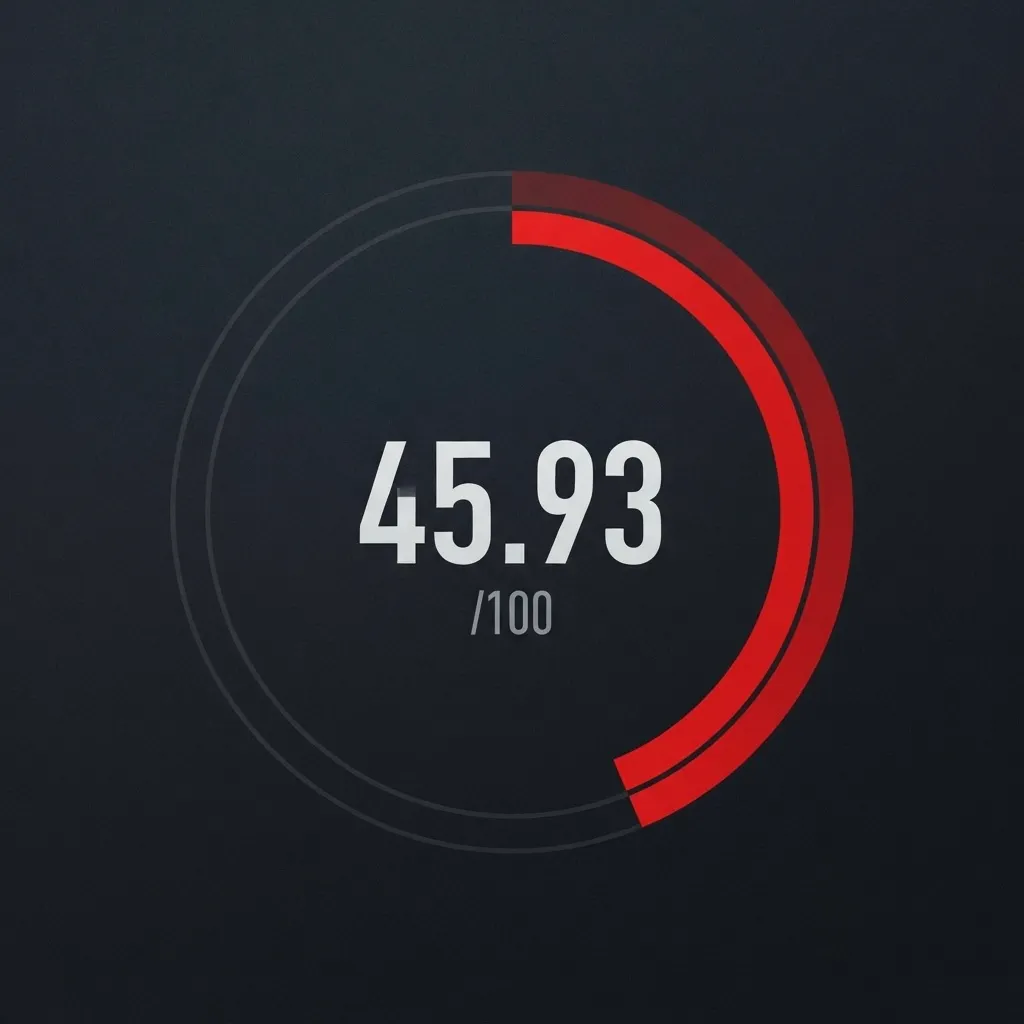
On a separate index, the Global Index on Responsible AI, Nigeria went from 80th globally with a score of 7.21 in 2024 to 38th globally with a score of 45.93 in 2026, making it the highest-ranked country in Africa, ahead of Egypt.
Both of those numbers are genuinely good news, so this piece isn't about the numbers. It's about what the number is actually measuring, and what happens when a country gets very good at climbing a ranking without the thing the ranking was supposed to represent actually following it up.
Climbing the ranks
The Oxford index breaks its overall score into pillars: policy capacity, governance, AI infrastructure, public sector adoption, development and diffusion, and resilience. Nigeria's strongest single result is 35th globally in Policy Capacity — built almost entirely on the existence of a National AI Strategy. This is the same strategy examined earlier, the one with no credible implementation plan and no serious budget allocation attached to it. The document exists, it counts and it moves the number very efficiently.
Nigeria's weaker results sit in the pillars that measure whether any of that policy translates into something real, like infrastructure, adoption or execution. The index's own summary of Nigeria's result says this plainly: the country presents "clear AI ambition but uneven execution, with policy advances outpacing adoption in government services."
That sentence is doing more work than the headline ranking is. It's the index quietly admitting that what Nigeria is good at, right now, is producing the kind of document that scores well, but not the kind of infrastructure that would make the score mean anything to someone trying to build here.
Policy documents are the cheapest thing a government can produce.
A national strategy takes a workshop, a consultant, and a press cycle. Building compute infrastructure Nigerian startups can actually afford to use takes years and real capital, most of which has been documented, in detail, as either absent or diverted elsewhere. A functioning satellite constellation requires a budget line that has survived contact with an Auditor-General's report. None of these appear in a Policy Capacity score. All of them appear, eventually, in whether AI does anything for the country beyond generating rankings to announce.
So the index disproportionately rewards the exact layer Nigeria already knows how to produce at scale. Announcements. Frameworks. Strategy documents launched at prestigious venues with ambitious language. The country isn't gaming the index in the sense of lying to it — the strategy really was published, the data protection act really was passed. It's gaming it in the softer sense of correctly identifying which inputs are cheap to produce and heavily weighted, and producing a lot of those, while the inputs that are expensive and heavily weighted elsewhere continue to lag.
A country moving from 103rd to 72nd is doing something differently than it was two years ago, and the people who wrote that strategy, passed that data act, and built the policy scaffolding deserve credit for it existing at all. Most Sub-Saharan African governments still don't have a coherent AI strategy on paper. Nigeria does, and that's not nothing.
But there's a specific kind of danger in a number that moves faster than the thing it's supposed to represent. It becomes very easy, and very tempting, to treat the ranking as the achievement rather than as an early, partial signal of one. "AI is built on numbers, and Nigeria has the numbers," the minister said at the announcement of a new AI centre in January.
"Can Nigeria move into the global top 50 for AI capability?" is a commendable ambition to hold when you realize the global top 50 for capability is not the same claim as global top 50 for having written a strategy about capability.
The temptation isn't confined to government. In the days after the GIRAI result went public, a senior executive at a major Nigerian communications and satellite agency posted a message celebrating the climb in almost identical language to the minister's own — "rankings don't build the future, people do," followed immediately by crediting the ranking to the students, founders, and engineers building things on the ground. It's a generous and well-meant sentiment that unknowingly inverts the actual finding: the ranking that climbed is the one measuring policy documents and governance frameworks.
The grassroots builders it was credited to are not what moved that number, and the index's own language says as much. When the people closest to the infrastructure gap start reading a policy score as evidence that the gap has narrowed, the announcement layer has stopped being something the government produces and started being something the wider ecosystem produces for itself.
The same post described this moment as evidence that Nigeria is "building the foundations for responsible AI." That sentence is doing a lot, and I mean…. a lot of work. A foundation is not an incomplete document. It is not a ranking. It is the structural layer everything else gets built on top of — compute, power, data infrastructure, the kind of thing that has to exist before the applications built on it can exist.
Nothing examined elsewhere in this body of work suggests that layer is being built. N-ATLAS runs on Amazon and Google's infrastructure, the satellites the NIGCOMSAT relies on for basic geospatial and population data are years past their design life and replacements are not scheduled to arrive until 2028 and 2029 with two big IFs:
- If the current government is reelected
- If the next government actually sees it through
The agency responsible for one of those satellite programmes is the same one whose Auditor-General flagged ₦2.9 billion in unresolved financial irregularities the same year.
That is the clearest absence of any discernible foundation.
"Highest-ranked in Africa" is also doing more work than the underlying numbers support. Nigeria's 45.9 sits ahead of Egypt's 41.3, Kenya's 39.5, Ghana's 38.4, and a cluster of other countries trailing closely behind — but the entire continent, top to bottom on this index, is packed into a narrow band below 50 out of 100.
Nigeria isn't pulling away from the pack. What we are, is the tallest person in a room where nobody has cleared the halfway mark... Giants of Africa so to speak.
Indulge me a bit.
If you had one child, and that child had struggled for years, scoring in the low 30s on a very important test, and this was finally the year they broke through to 45. Would that be a cause for celebration, or a quiet exhale and a clear-eyed acknowledgment that there is still a great deal of work left to do?
Most parents know the answer instinctively. You'd be relieved. You might even be proud of the effort. But you would not throw a parade for a 45/100 (F), and you certainly wouldn't stop paying attention to what comes next.
One child is, statistically, almost nothing — roughly 0.0000000120% of the people alive on Earth. A single, specific, singular person, whose progress or lack of it changes nothing about the world at large.
Nigeria is not that. Nigeria is close to 2.9% of the entire human population and one of the largest single population blocks on the planet, larger than the United States and Canada combined. If a 45 out of 100 wouldn't be cause for real celebration for one child who barely registers as a statistic, it is worth asking why it becomes cause for celebration for a country holding this much of humanity inside it.
At best, this is a participation trophy. The country genuinely showed up, wrote the strategy, passed the data act and climbed the kiddies table. But a participation trophy has never meant you won anything.
You didn't build the thing, but at least you tried, so here's a ranking for your "group"
We are indeed climbing through the index.
What's worth watching is whether the climb continues to the point where the index starts weighting the expensive parts more heavily than the cheap ones — because that is the only part that a founder trying to build something here will ever actually feel.