
The Architecture Underneath the Market

There is something interesting about the way successful businesses grow in African cities.
A business can be almost completely unknown outside a particular area and still be remarkably successful within it. A fashion vendor becomes the person to call. A mechanic becomes the mechanic everyone around here uses. A technician gets so many referrals that advertising becomes almost unnecessary.
Eventually, the business develops something more valuable than visibility: local trust. And once that trust exists, geography starts working in the business's favor. Customers are nearby and they know someone who has bought from it. They can verify it exists by walking past it. If something goes wrong, the business is still there tomorrow.
The business doesn't need to convince a whole city that it exists. It only needs to remain relevant to the people around it.
I used to think the lesson here was about discovery. I now think it's about something deeper, and it took me a while to see it.
The interaction underneath the transaction
Start with what a purchase actually is, because we've abstracted it so heavily we've forgotten.
As a customer, you don't just move from I see product to I buy product. There's an invisible sequence running underneath:
- Do I trust them?
- Do I want this?
- How much do I want it?
- Can my balance afford it?
- Will I actually receive what I expect?
- Was it worth it?
- Would I do it again?
- Would I recommend you?
The defining moment of this journey is the point where you stop questioning the seller's credibility entirely. The question quietly changes from can I trust you to how badly do I want this, and with a tempting enough offer, to how much can my balance afford. That transition is the sweetest spot for the seller, and it happens in the first half of the interaction.
Your sweet spot comes later, when you receive your haul, and an abstract promise becomes a physical thing in your hands that turns out to be what you hoped.
Both of these moments are the most delicate parts of an intricate dance, one that most people fail to even recognize as a dance.
Build something people want, yes.
But never confuse one of humanity's most defining rituals of interaction for mere numbers.
The logical temptation
Most will say: no, we're not reducing it to numbers because we have marketing, we manage logistics, we do customer acquisition… We account for all of it.
But that is exactly what you're doing if you don't see the real architecture. You're measuring the outputs of a system without understanding the system itself.
When people think of architecture, they mostly think of roads and power, but forget the mental architecture.
How do people think? How do they respond to opportunity? How do they perceive risk? How do they establish trust? How much friction will they tolerate? How has the economy around them trained them to behave?
These things are infrastructure too. They just aren't infrastructure you can see on a map.
Why borrowed models keep breaking here
The more I come across competitors on Instagram, the more it feels like being in the backrooms. I see a copy of a copy of a copy, each with its own distinct uniqueness, strength and flaws. At first it filled me with dread, wondering how one could actually stand out in such a crowded market, and if it was even worth the effort to begin with.
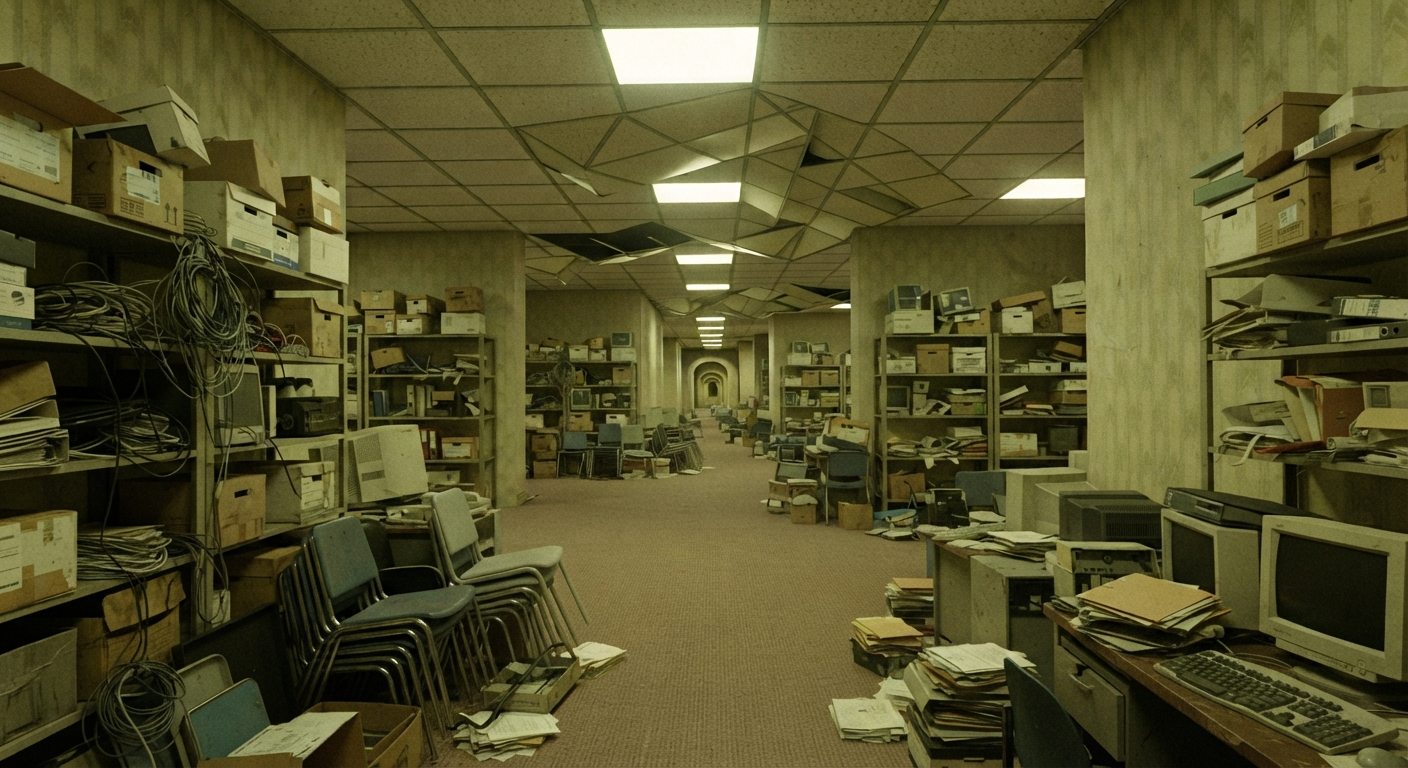
Till I started to notice the patterns. The more you look, the less you see, till the moment you've figured out what to look for, at which point, you've pretty much beat the game. You can study a market and see roads, warehouses, payment systems, marketplaces, storefronts. All of it convincing, all of it surface.
So how does a copy stand out in this economy? It buys attention. Influencer promotions, discount runs, free-gift giveaways, a constant drip of paid propaganda. And for a while it works. The numbers climb, the launch looks like a success, the deck writes itself.
But paid reach only runs as long as the money does. The moment the burn stops, so does the growth, because none of it was ever converted into something that holds. You rented an audience without realizing the trust was always someone else's, on loan for as long as you kept paying, and the day you stop is the day you find out you built nothing underneath.
Yet underneath is another infrastructure entirely—how people think, trust, negotiate, respond to scarcity, decide what's worth risking money on—and it stays invisible until you build something that depends on it. Then, suddenly, the numbers stop adding up and nobody can say why.
The failure to account for that invisible layer is a large part of why the Nigerian startup landscape is littered with platforms that raised money, launched loudly, and quietly disappeared. We keep transplanting structures built for developed markets into an environment that runs on a completely different architecture, and then acting surprised when the numbers stop making sense.
Take Buy Now, Pay Later. It works in the United States because the architecture underneath it works: enforceable repayment, credit scoring, predictable consumer credit behavior. The product is the visible part, but the enforcement layer that everyone seems to gloss over is the actual machine. If you transplant the product without the machine, then you haven't launched BNPL, you've launched unsecured lending with better branding. It's not that BNPL is impossible here. Of course, Nigerian BNPL businesses exist. The ones surviving are the ones that rebuilt the assumptions underneath, not the ones that simply copied the interface.
Cash on Delivery is the same story from the other side. On paper it's the perfect answer to the trust problem: the customer risks nothing. In practice it doesn't remove risk, it relocates it to the seller and the logistics network, in an environment where failed deliveries and refusals are expensive. The visible feature solves the visible problem while the invisible architecture quietly bills someone else.
Same-day delivery sounds like an obvious competitive edge until you price the storage, the congestion, the roads. The assumption underneath it is logistics economics that simply don't survive contact with the terrain.
None of these are operational problems. They're architectural problems that maintain a consistent downside pressure on the outcome in spite of the efficiency of execution simply because the model was built on broken assumptions.
The invisible architecture is measurable
It's a pattern that shows up in research, repeatedly, once you know to look for it.
GSMA research covering MSMEs across Nigeria, Ghana, Kenya, Egypt, Ethiopia and South Africa found that 48% of surveyed businesses identified customers' lack of trust in e-commerce marketplaces and websites as a challenge to growing their e-commerce business. The same research flagged delivery infrastructure and the absence of national addressing systems as core problems. Nearly half of merchants are saying the binding constraint isn't inventory, capital, or demand. It's whether the customer believes the transaction will go the way it's supposed to.
Studies of Nigerian e-commerce keep landing in the same place: trust, perceived risk, convenience and website quality drive online purchasing behavior, with trust both directly affecting purchase intention and mediating the effect of convenience on behavior. Research on emerging-market social commerce finds familiarity and trust mediating exchanges between buyers and sellers, with word of mouth increasing people's propensity to search for products at all.
And proximity has its own evidence. Nigerian retail research found consumers more likely to patronize stores closer to them, with proximity still mattering even where distant retailers had established relationships with those same customers. McKinsey's research on Nigerian consumers identified a segment it called local store devotees: people who trust local stores over larger retailers and frequent the stores their families favor. The same research found significant regional differences in purchasing attitudes.
Nigeria is not one market. Lagos isn't Abuja, isn't Kano, isn't Port Harcourt and even within Abuja, Wuse and Garki aren't the same marketplace either.
What the local seller answers without speaking
Put the research and the trust sequence side by side and you see what a local business actually is: a machine for answering the invisible questions cheaply.
- Can I trust this seller? Someone nearby already knows them.
- Will they actually deliver? They're two streets away.
- Where exactly are they? You can point.
- What happens if there's a problem? The seller is physically reachable tomorrow.
- Who else buys from them? You've seen the shop busy.
- Is this relevant to me? A local seller understands local demand because they live inside it.
Each answered question is acquisition cost the business never has to pay, and that's exactly why word of mouth can substitute for advertising in a community as trust and proximity continuously reinforce each other.
Localization is not translation
Which brings me to what localization actually means, because the standard definition is part of the problem.
Localization is not changing the language on the website. It is not putting the price in Naira and it is not a currency dropdown and a Lagos office address for a Delaware C-Corp running on a high trust model.
Localization is understanding the architecture underneath the market you are entering, and adapting your assumptions to it. The behavioral layer. The trust layer. The enforcement layer. The economic memory of the people you're asking to risk their money on you.
By that definition, most platforms that "localized" for Nigeria never did so at all. They simply translated and camouflaged… badly.
What the community already solved
Before marketplaces became websites, communities already had discovery systems. You asked your neighbor. You noticed which shop was always busy. You heard someone had used a particular tailor. Reputation traveled through people, and proximity did quiet work the whole time: the local business answers half of the trust sequence without saying a word. Its location is visible. Its customers are nearby. Its existence is easy to verify.
The system has one major limitation though. Its reach is capped by the network of people you know. So a business can be excellent and remain invisible to thousands of potential customers a few kilometers away.
That's the actual opportunity. Not another giant catalogue; there are plenty. The opportunity is to digitize the trust network itself. To preserve what the architecture does well and remove its one constraint.
Discovery, rebuilt on the right architecture
Imagine searching for a pair of shoes.
A conventional marketplace asks: what shoes are available? That optimizes for inventory.
A marketplace done right asks: what shoes are available around you, from businesses people around you trust?
That optimizes for relevance, and relevance is what the trust sequence actually runs on. A business trusted by 500 people in your immediate environment is more relevant to you than a business trusted by 50,000 people somewhere else. Conventional rankings can't see that distinction even though for this market, it's the most important one there is.
And this reframes reputation itself. A business's reputation is not a single number. It has a geographic dimension. Open a second location and you carry your brand with you, but not your trust network. The new location has to earn its own. Any system that scores reputation as one national figure is measuring the visible architecture and yet again, missing the real one.
So what should a serious marketplace actually be able to show about a business?
Brand overall: 4.8 across 2,400 completed orders. Abuja: 4.9, 820 customers, 320 of them repeat. Lagos: new location, 14 customers, 12 of them repeat.
Same business, three different truths. The business travels, the brand travels with it, yet the trust network doesn't. A platform that measures reputation this way can transfer some of a business's accumulated credibility to a new location while still being honest that local trust is earned locally.
The question it answers isn't "how trusted is this business?" It's "how trusted is this business here?"
Density is the metric
This reframes what makes a marketplace valuable at all.
A hundred merchants spread across Nigeria and a hundred concentrated within ten kilometers of a user are, on paper, the same marketplace. In reality the second is dramatically more useful.
Marketplace value was never "how many sellers exist."
It's how many relevant sellers exist within a useful distance of this buyer.
That gives you metrics worth building around: local supply density for relevant products available within a radius, and eventually local trust density, the number of trusted sellers within reach of a given buyer. Those numbers describe what a marketplace is actually worth to the person standing in a specific place, which is the only vantage point a buyer ever has. And it means the platform doesn't need millions of users before it becomes useful. It needs density in one place.
Density also compounds. More local sellers means more local inventory, which means better local discovery, more local buyers, more transactions, more local reviews and social proof, better ranking of trusted businesses, more sales per seller, more sellers wanting in.
The flywheel runs community by community. You don't solve "Nigeria's marketplace" on day one. You solve "what's worth buying around me", then expand the radius.
Let's be precise about this
The lazy version is that local recognition makes businesses profitable. That's false. A vendor can be famous in their area and still have bad pricing, thin margins, weak operations, or customers with no purchasing power. Locality doesn't fix a bad business.
My position is more nuanced: in fragmented, trust-sensitive markets, geographic proximity reduces the cost of discovery, trust, fulfillment, and customer acquisition. Once a business is trusted within a local network, that network generates demand without requiring continuous broad-market advertising. Local trust plus local discovery equals more efficient acquisition and conversion, not automatic profit.
Every component of that claim has evidence behind it. What remains to be demonstrated is whether localized discovery, built deliberately, produces measurably lower acquisition costs, higher conversion, and higher repeat purchase rates than the catalogue model.
That's the experiment: buyers shown locally trusted merchants converting and returning at higher rates, merchants receiving localized discovery acquiring customers at lower cost. It's a falsifiable claim, and we're building the instrument that tests it.
Local does not mean small
The obvious objection is that localization caps your scale.
Okay… please explain to me, then, why someone would ditch the seller down the street with the same quality, probably lower price, who has been reliable for as long as they've known them and only takes a few hours to deliver, for your business. Because if you do, that's the question everyone will ask you, with the silent assumption that you probably have a quarrel with the seller nearby. It's simply illogical.
And that stickiness is exactly why the objection has it backwards. Local trust doesn't cap your scale. It's what makes every community you win into defensible ground that stays held while you go win the next one.
A business dominates one area, then another. A restaurant wins one part of a city before expanding. The loop is old and it works: local visibility, first purchase, good experience, trust, repeat purchase, word of mouth, stronger local reputation, lower friction for the next customer. Then you replicate the loop in the next community.
Build trust locally. Make that trust discoverable. Expand. Build trust again. Repeat.
The internet gives a business the ability to scale its reach but localization, real localization, is what lets it remain relevant while it does. Scale doesn't have to mean abandoning locality.
The oldest distribution system we have
The internet's original promise was reach. Anyone could sell to everyone, and for a moment that was an advantage. But an advantage everyone holds very quickly becomes the baseline, and reach that everyone has, turns to noise. When every business can be visible to every customer, visibility is no longer the constraint. Relevance is.
The harder problem, in markets like ours, is surfacing what is actually worth discovering… an architectural problem hidden in plain sight by the blind acceptance of borrowed dogma.
I've become increasingly convinced of this while building commerce infrastructure here. The future isn't making every business visible to everyone. It's making the right business visible to the right community, on top of the trust architecture it already runs on.
If we do that well, we would be digitizing one of the oldest and most powerful distribution systems we already have: the community.
This piece pairs with Two variables that will decide if AI skips Africa and Infrastructure doesn't pitch well, yet it wins anyway. The demand side of the same discussion.