
Two variables that will decide if AI skips Africa
The IMF just published its first serious economic model of AI in Sub-Saharan Africa and the math is surprisingly easy to understand, even if you don't have an economics background. It explains something I've been working on from different directions over the past few years.
The two numbers that matter
The IMF ran the same productivity model used for the US and Europe, but for Sub-Saharan Africa.
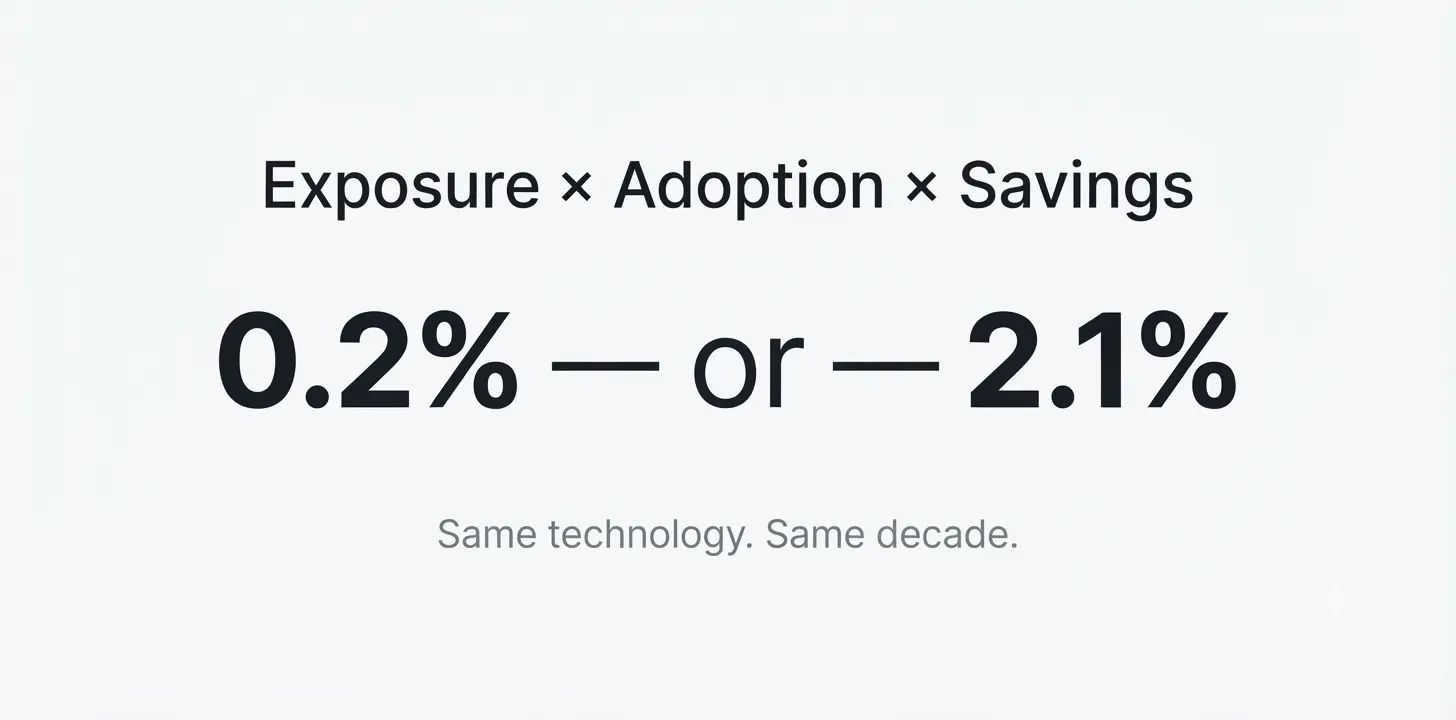
Under current conditions, AI adds 0.2% to the region's productivity over the next decade. Under a high-adoption scenario, that number becomes 2.1%, with a GDP effect of about 4%.
That's a 10x difference. Same technology, same region, same decade.
So what determines which number you get? Definitely not the technology. It's the conditions around it.
To see why, you need to look inside the model itself, and it's simpler than you'd expect.
The whole model is three numbers multiplied together
Strip away the notation and the IMF's framework says productivity gain equals:
Exposure × Adoption × Savings
- Exposure: what share of work can AI actually touch?
- Adoption: what share of firms actually use it?
- Savings: when they use it, how much more productive does each task get?
Multiplication is the important part. If any one of the three numbers is near zero, the whole result is near zero, so it doesn't matter how good the technology gets.
Now plug in Sub-Saharan Africa's current numbers:
- Exposure: only about 22% (0.22) of jobs are meaningfully touched by AI, versus roughly 55% in Europe.
- Adoption: under 10% (0.1), two to three times lower than Europe or the Americas. Multiply those two small numbers together, then by a per-task saving of roughly 10%, and you land at 0.2%.
The equation tells you exactly where the leverage is. You can't do much about the third number because task-level savings are set by the technology itself. But the first two are set by us. Exposure and adoption aren't untouchable laws of physics. They're the results of decisions about infrastructure, products, and policy.
Everything I've worked on sits somewhere in those two variables.
Think of AI like power tools in a village without electricity
Imagine shipping a container of power tools to a village with no grid.
The tools work perfectly. The people are skilled. But nothing happens because the tools need something the environment doesn't provide yet.
That's the adoption variable in physical form. AI raises productivity when it is paired with reliable power, connectivity, skills, and institutions.
Economists call these "complementary conditions", but I like to think of them as the grid. And the grid problem is not abstract. Seventy-eight percent of firms in the region report routine power outages, losing 8.4% of annual sales against a 5.2% global average. Eighty-six percent of Nigerian firms own or share a generator.
When your baseline is "the power might not be on," a cloud-dependent tool is a hard sell, no matter how impressive the demo.
The "low exposure" number is partly a measurement trick
Here's where it gets interesting, and where I think the IMF's own report quietly argues against its headline number.
The exposure measurement works by decomposing jobs into tasks and asking: can current AI do this task?
By that method, farming scores near zero because a farmer's tasks are mostly physical… AI can't plant maize, can it?
But watch what happens when you ask a different question: not "can AI do the farmer's tasks?" but "can AI close the farmer's information gaps?"
Typical crop yields in the region run at 25–33% of potential. This was never a skill issue… this is simply because they lack real-time information about weather, soil, pests, prices, and timing. A randomized trial of an AI-powered SMS advisory service found a 16.6% yield increase and 23% income increase in a single season. Over SMS. On feature phones. No grid required.
The IMF ran this logic through its own model. Extending AI into agriculture alone adds 0.8 percentage points — the single largest lever in the entire framework, four times the size of the current-conditions total.
Exposure isn't about the job itself. It is about how you deliver the intelligence.
When you measure agriculture by task automation, it is unexposed, but when you measure it by decision support, it becomes the biggest opportunity on the continent.
The same reframe applies to informal commerce — hold that thought.
Follow the money: the consumer trap
Before the optimistic part, we need to sit with the uncomfortable part. This is the section where I want you to feel the weight.
Say a Lagos business adopts AI tools and becomes 20% more productive. Good outcome, right? Now trace where the money goes.
The subscription is priced in dollars. The model runs on servers in Virginia or Dublin. The chips came from one company, the cloud from three. So every month, a business earning in naira converts to dollars and sends value up a stack it doesn't participate in — at any layer.
Now multiply that across an economy. Millions of businesses, all more productive, all converting local currency to dollars for the same imported input.
Individually, this is very rational. Collectively, it's sustained pressure on the exchange rate, and a growing structural dependence on infrastructure priced in someone else's currency and governed by someone else's rules.
This is what I mean by the difference between consuming AI and participating in it. A consumer relationship concentrates gains at the point of production and extracts them from the point of use. We've seen this loop before — raw materials out, finished goods in, value captured elsewhere. The commodity this time is intelligence, but the geometry is old.
The IMF says this in institutional language: dependence on foreign providers, infrastructure that is "expensive, concentrated, and shaped by geopolitical fragmentation." I've written about it in blunter language here.
Either way, the productivity gain is real and the extraction is real. Both things are true at once, and any honest strategy has to hold both.
Governance is a negotiating position, not a rulebook
This is the question that produced NEAIF, the AI governance framework I published for the Nigerian context.
Most governance frameworks start from deployment: systems exist, people use them, how do we regulate? While that sounds like the best question for Brussels, it's the wrong first question for Abuja because it assumes you already have leverage over the systems, which you don't.
Think of it like showing up to a trade negotiation with nothing the other side wants. People are selling jet engines, long-distance drones, silicon chips, enterprise SaaS subscriptions, but all you have is a "growing population with immense potential", and a dwindling stock of raw cocoa.
You can write all the rules you like. Nobody has a reason to sit at your table unless there is an opportunity for exploitation.
What gives you a seat? Mostly, data. AI systems are hungry for data they don't have — local languages, local commerce patterns, local agricultural conditions. A country that controls well-governed, high-quality local datasets has something to trade. A country that doesn't is a rule-taker.
That's the argument of Governing by Data, NEAIF's companion framework: build the data position first, because it converts governance from a compliance exercise into a bargaining chip.
I got some of this wrong, by the way. I underestimated how long governance work takes to gain traction without institutional backing, and learned that being early and being legible are very different things. The IMF now modeling this same terrain doesn't automatically prove the frameworks right, but it strongly shows that the conversation finally has a shared reference point.
What the mobile money story teaches us
Now this is the encouraging part, and we'll discuss it using the IMF's own example.
Sub-Saharan Africa never built landline networks at scale. Mobile phones arrived, and the region skipped the landline era entirely. Today it holds 1.2 billion of the world's 2.1 billion registered mobile money accounts.
The world leader was built on top of a skipped layer.
The mechanism matters more than the outcome. M-Pesa worked because it met people exactly where they were: feature phones, cash economies, no bank accounts. It didn't ask users to first become "banked." It made the old prerequisite unnecessary.
That's the design pattern: don't drag people up the old staircase. Build the new floor under their feet.
Building for the layer that's forming
Apply that pattern to commerce, and you get the bet behind Paylo.
Picture a merchant selling shoes in Aba. She's good at her business. Her entire commercial existence runs through WhatsApp and cash transfers.
By the IMF's measurement, her job has near-zero AI exposure. The e-commerce era mostly skipped her because websites cost too much, platforms took too much and centralized logistics didn't reach her.
Here's what's changing underneath her: people are starting to ask AI assistants what to buy. "Where can I get quality leather shoes near me?" When that question gets asked, the AI answers from whatever structured commerce data it can reach. Today, our merchant doesn't exist in that answer simply because she has no surface the AI can see. Nothing dramatic happens to her yet, but every buyer who asks an AI instead of asking around is a buyer she never knew existed.
So that's what we build. Paylo gives her a storefront that is structured data first and a webpage second. We run an MCP server — a standard interface that lets AI systems query our merchant catalog directly, the way apps query a database. We detect AI platforms hitting the API so we can see the discovery layer forming in real time.
Notice what the merchant has to learn about AI for this to work: absolutely nothing.
She lists her shoes. The layer does the rest — the same way an M-Pesa user never needed to understand telecoms infrastructure. In the model's terms, we're not waiting for her to become exposed. We're manufacturing the exposure and handing it to her.
And notice what this does to the extraction loop from earlier. Discovery happens on foreign models — that layer we don't control yet. But the merchant relationship, the transaction, the commerce data, the local rails? Those stay home. That's a participation position, not a consumption one. Partial, imperfect, but structurally different.
The window is real
The IMF's conclusion is blunt: the gap between the paths is 10x, the default path is the low one, and the choices being made right now decide which path holds.
Windows like this don't stay open. Network effects and scale economies mean early positions compound — the report itself warns that digital industries concentrate, and that late movers end up renting infrastructure from early ones. Every year of drift makes the low path harder to leave.
I find that clarifying rather than alarming, because it makes the work legible.
- Move the adoption number: grid, connectivity, products that survive an outage.
- Move the exposure number: build surfaces where the measurement says there's nothing.
- Hold the gains: data positions and governance that give you something to negotiate with.
Different people are working on different pieces. Frameworks are one, products are another, and writing the structure down is a third.
None of it is finished so it is important to actually take the IMF paper for what it is: a data point that makes the conversation easier to have, rather than a grim conclusion on our collective future.
This piece pairs with Infrastructure doesn't pitch well, yet it wins anyway. It's the same window, seen from the capital side.